Sarah Lewis must have strong claims to be most widely-known unknown person in Victorian Britain. Her book Woman’s Mission, first published in 1839 and reprinted 16 times in the next 15 years was enormously influential. Along with the contemporaneous works of Sarah Stickney Ellis (1799-1872), including the Women of England (1839), Lewis’ book formed the bedrock of early Victorian ‘separate spheres’ ideologies. Elizabeth K. Helsinger’s extended discussion in The Woman Question. Defining Voices, 1837-1883 (1989) illustrates how Lewis’ forceful claims for the special and vital role women were called to play have long been recognised as seminal for the emergence of at least one version of nineteenth century feminism.
And yet hitherto to all intents and purposes almost nothing has been known about her. All seventeen editions or printings of Woman’s Mission were published anonymously, and contained no hint as to the background of the author. To be sure, within a year or two the name ‘Sarah Lewis’ came to associated with the book as its author, but almost all the discussion and invocation of the book in the 1840s and 1850s proceeded without any direct attribution.[i] On the basis of some observations in the only other piece of writing that can be attributed to Lewis, an essay ‘On the Social Position of Governesses’ in Fraser’s Magazine for April 1848, some historians have identified her as a governess. But that is as far as it has gone, and the writer of her entry in the ODNB was forced to concede complete ignorance and simply discuss her seminal volume and its impact.
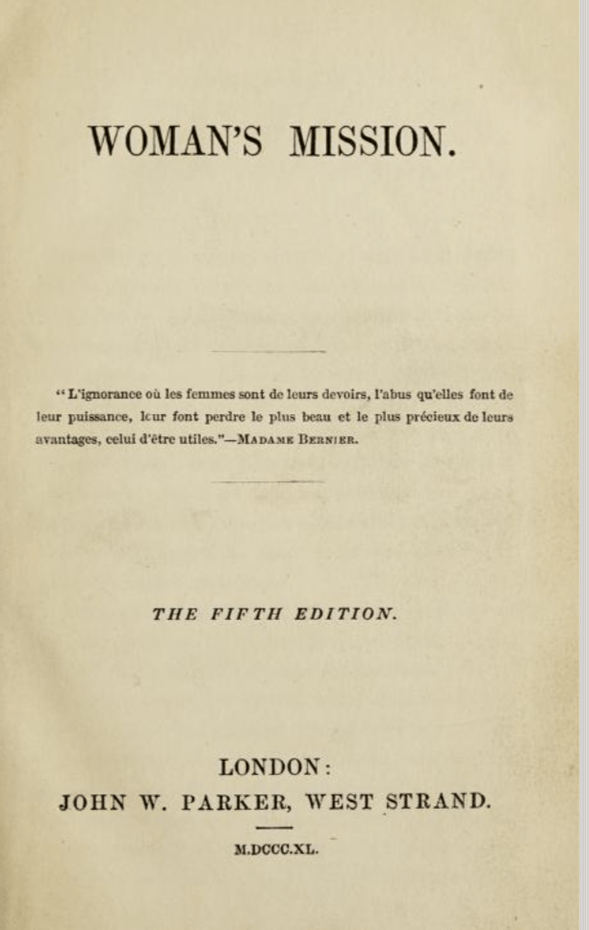
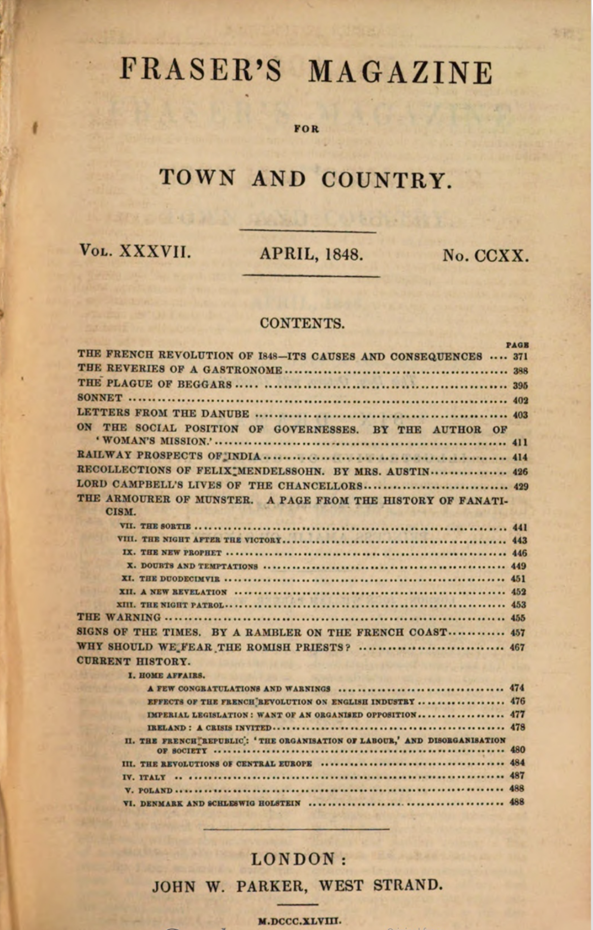
And perhaps this doesn’t matter. After all, it is the influence of Woman’s Mission which is of crucial importance, and there is plentiful evidence of that, not just in the 17 English editions, the American copies, the widespread attention given to them in the newspaper press, and the extent to which they helped to shape the terms of the debate over the position of women in Victorian society, for both proponents and opponents. When early- and mid-Victorians deployed the language of ‘mission’, ‘sphere’ or ‘influence’ they were not necessary simply adopting Lewis’ versions but they were consciously addressing concepts freighted by the discussions in Woman’s Mission. And when figures like Anna Jameson sought to articulate their own versions of the proper role of women, time and again they did so in direct engagement with Lewis’ work.[ii]
And yet without biographical moorings we are unable to understand the context from which Woman’s Mission emerged, the specific personal dynamics which facilitated its particular formulations, not to mention some sense of the personal and institutional networks which might have encouraged its dissemination and popularity. Hence the significance of the references buried in a review of the Edwardian reprint in The Queen, 1 September 1906, which have just come to light, that the author Women’s Mission was the Sarah Lewis who, with her sister Ann, conducted a school for girls in Putney, and that it was here that she developed the ideas that formed the book. With this information, Sarah Lewis can finally be freed from her cloak of anonymity. The census records show that between 1841 and 1861 she and Ann were living on High Street, Putney; for the first two with a couple of teachers and around 35 girls. Although there is no definitive birthdate or baptismal record, the evidence is that Sarah was born in 1807, and that after retiring in 1870, she died in 1878, shortly to be followed by Ann.
Unfortunately despite sustaining her school over several decades, Lewis seems to have made little further impact on the historical record. There is some evidence of her involvement in the Home and Colonial School Society, an Anglican association established in 1836 to promote progressive educational ideas, and especially the approaches of Pestalozzi.[iii] And she was clearly associated with parish of St Mary’s, Putney, where Bishop West’s Chapel was restored and decorated after the death of the sisters in 1878 in remembrance of them.[iv] It is still not possible to identify her parents and family background (her death certificate lists her father as ‘George Lewis, merchant’); or to ascertain anything about her upbringing, or wider life.[v]
It is not much to go on. But the names of the resident pupils contained in the 1841 and 1851 enumerators’ returns do show that the sisters were able to recruit pupils from a very broad geographical spread, across England and Wales, from Ireland, and perhaps (as in the case of Emma Graham, daughter of John Graham and later wife of Sir John Frederick Croft, born into one of Oporto’s emerging port houses and marrying into the family of another) from further afield.[vi] Closer examination of the surviving pupil lists suggests that this success rested at least in part on an extensive network of connections with some of the richest Unitarian families in England and Scotland, including the Martineaus of Tulse Hill, the Stansfelds of the West Riding, the Gairs of Liverpool, and the Pagets of Leicestershire.[vii] Insofar as this is the case, the Lewisses school seems to have played a significant role in that progression of Unitarianism from radical sect to respectable section of the Anglican Liberal establishment which was taking place during the second and third quarters of the century.[viii]
In turn, the school moulded the development of a significant cadre of women, who returned to their communities and family networks to live and marry, carrying with them at least some of Lewis’s ideals about the role of women in society. Quite how many is unclear, but the retirement of the sisters in 1870 was marked by an illuminated scroll and a gift of £666 presented by 283 former pupils.[ix] They included Lucretia Gair (c.1824-1859), a pupil at the school in 1841, daughter of Samuel Stillman Gair, partner in Baring Brothers, who in 1847 married William Rathbone VI (1819-1902), scion of the Liverpool banking family and prominent social reformer. And Annie Sutherland (1837-1917), who had been brought up at Shibden Hall, Halifax, by her aunt Ann Walker and Walker’s partner Ann Lister, who married William Henry Stansfeld, of the West Riding Stansfeld and Milne families, becoming a prominent figure in the political and social life of the district around Wakefield.[x] And also Jane Bacon (1834-1910), daughter of George Peter Bacon, proprietor and editor of the liberal Sussex Advertiser, who remained close to Sarah and Ann for the rest of their lives, while becoming a prominent philanthropist in Hastings, serving ultimately as Hon Sec of the Maternity Society and Children’s Home.[xi]
No doubt now the identification has been made, further insights into Sarah Lewis’ life will be discovered. For the moment, though, we can begin to see a figure whose public significance as the author of Woman’s Mission was paralleled by a private influence which spread its own tentacles across Victorian Britain.
Martin Hewitt
[i] For notices which identified her, see for example, Naval and Military Gazette, 28 April 1842; Era, 11 December 1842.
[ii] Anna Jameson’s ‘Woman’s Mission and Woman’s Position’, Athenaeum, 18 March 1843, 257-59.
[iii] See Quarterly Educational Magazine 1 (1848).
[iv] Illustrated London News, 4 January 1879. For the death of her sister, Ann, see London Evening Standard, 4 November 1878.
[v] There must have been some family wealth for the sisters to have acquired the large property in which the school was conducted, and in her 1861 census entry (she was visiting in Hastings at the time), Ann Lewis is described as ‘Fundholder’.
[vi] It should be noted that in the absence of direct testimony from or describing the individuals which links them explicitly to the Putney school, the discussion here relies on record linkages which would not always pass muster. Part of the justification for this is that the number of apparent linkages pointing in the same direction which give added weight to each individual identification.
[vii] And possibly other Unitarian families as well, including that of Robert Scott of Stourbridge.
[viii] See for example, D.G. Wigmore-Beddoes, Yesterday’s Radicals: a Study of the Affinity between Unitarianism and Broad Church Anglicanism in the 19th Century (Cambridge, 1971).
[ix] See O/446/002, London Metropolitan Archives.
[x] Surviving correspondence in the West Yorkshire Archives Service includes at least one letter referencing her time at the school, see Calderdale WYC 1150/74/32/1 as presented in the ‘In Search of Ann Walker’ website, https://insearchofannwalker.com/ann-walker-nee-sutherland-stansfeld/ . Charlotte Clark, one of Anne’s classmates at the school was the daughter of Fanny Clarke, the remarried widow of John Walker (1804), Ann Walker’s younger brother.
[xi] See obituary notices, Southern Weekly News, 24 September 1910, Hastings and Bexhill Independent, 29 September 1910. Jane was a main beneficiary of Ann Lewis’ will.
 Martin Hewitt