It is something of a truism that the assembly of Victorian ‘greats’ canonised by contemporary culture bears little relation to popularity or influence visible during the Victorian period itself. In the case of literature, the spread of public libraries in the second half of the century created a considerable body of data about the circulation of books which showed that, notwithstanding the powerful cultural capital adhering to the acknowledged elite of the literary field, actual borrowing preferences were a different matter. On the whole, George Eliot was eclipsed by M. E. Braddon.
Of course circulation statistics carry their own challenges. The frequency of borrowings of Darwin’s Origin of Species, librarians dryly observed, bore little relation to the frequency of its reading. Demand for the ephemeral novels of the season was unsurprising, and did not necessarily say anything about more enduring preferences or influence.
Which is why the emergence in the 1880s of newspaper and magazine competitions in which readers were asked to vote for their favourites – statesman, scientist, soldier or song, novelist or novel, poet or poem – should perhaps have been given more attention than hitherto. To be sure, these affairs generally had features which would leave a modern pollster aghast; not least that they generally required entrants to vote for the slate which they expected to be the most popular, rather than simply identify their own favourites. Nonetheless, here is a chance to gauge popular views as to reputation beyond the merely quotidian demand. And sometimes in considerable numbers. When in 1886 Cassell’s Saturday Magazine polled its readers on their choice of the twelve greatest living men (and this formal exclusion of women was an all too predictable and common feature of these exercises), the head of the poll, Gladstone, amassed 32,544 votes.
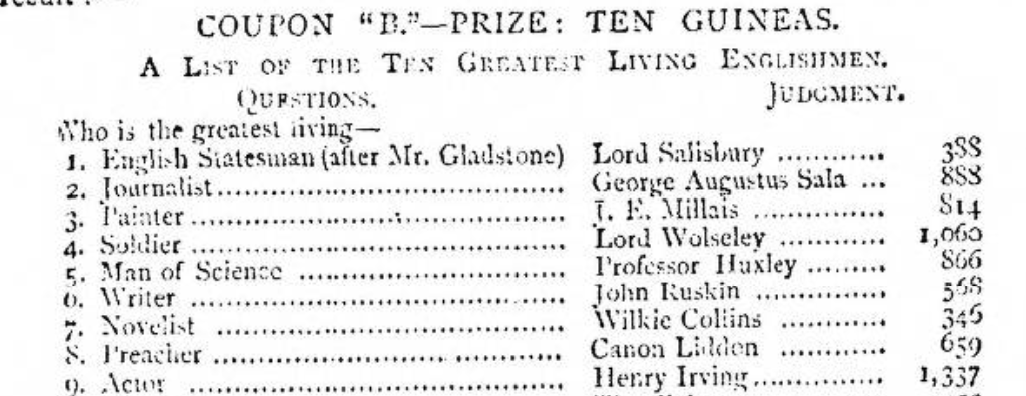
It is in this context that the poll organised by the Pall Mall Gazette in 1884-1885 is worth examining. The PMG in the 1880s is synonymous with the importation of American techniques of ‘new journalism’, not least sensational campaigns like the ‘Maiden Tribute of Modern Babylon’, which exploded in its columns not six months later. Its competition for Christmas 1884, which invited readers to nominate the greatest living Englishman in each of ten categories (with 10 guineas for a reader selected from those who matched the most popular in all 10 categories), although by no means a complete novelty, was very much part of this pattern. The results were noticed across the press; as was no doubt intended; we can think of it as an early sort of ‘click-bait’.
Some of the chosen categories were unsurprising: statesman, novelist, writer, artist, actor, painter, man of science: others less predictable, journalist, preacher, and ‘humbug’. Noticeably the poets and playwrights had to compete in the ‘writer’ category, and there was no place at all for musicians or sportsmen. The restrictions are also significant, even though none were rigorously observed: for ‘English’ was read ‘British and Irish’. ‘Men’ was not allowed to exclude women. ‘Living’ was more generally adhered to, though with ghosts aplenty, and of course involved the exclusion of many of the Victorian greats, Dickens and Darwin, Carlyle and Mill, Eliot and Thackeray, Peel and Palmerston, Wellington and Brunel.
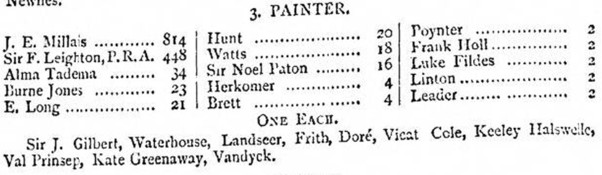
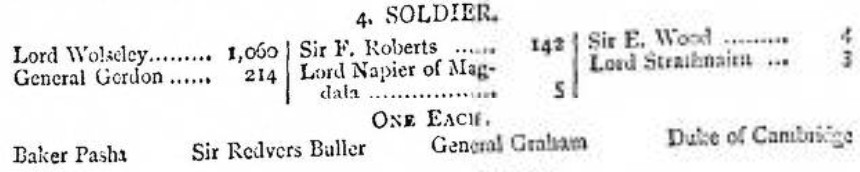

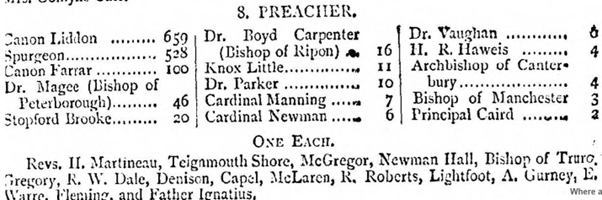
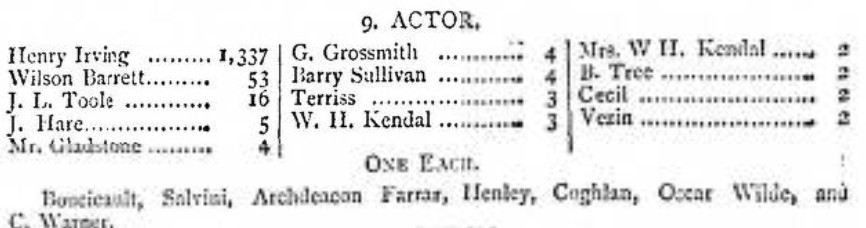
The results didn’t surprise contemporary commentators, who seemed generally willing to accept that they fairly represented a broader sensibility. In the ‘statesman’ category, Gladstone had been excluded as too obviously the winner, leaving the field spread and Salisbury emerging in an unconvincing first place with fewer than a quarter of the total votes. The novelist category was even more wide open, with Wilkie Collins’s first place deriving from less than 20% of the total votes, and there was a similar spread in the ‘writer’ category, although Ruskin attracted twice as many votes as his nearest challenger, Tennyson. Liddon and Spurgeon fought it out for pre-eminence amongst preachers, with Liddon prevailing by a relatively narrow margin. But winners in the other categories were more decisive. As journalist G.A. Sala, as artist Millais, as man of science Huxley, as soldier Lord Wolseley, and as actor Henry Irving, were all placed decisively at the head of their lists.
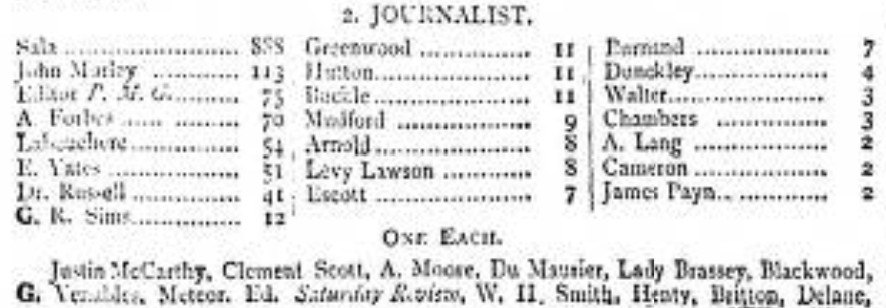
Sala is not a household name, but was by far the best-known miscellaneous writer in Victorian Britain, at this time synonymous with the journalism of the Daily Telegraph. Wolseley was the least recognisable of the list, but was in the forefront of the public mind in 1885 having led the British force sent to rescue General Gordon at Khartoum. The concentration of votes he received, and received by Irving, no doubt reflected the narrowness and indirectness of the knowledge of most contemporaries of figures in these categories. The concentration of votes on Huxley and Tyndall reflects the marginal place of science in Victorian culture. Had he not been excluded by his death three years earlier Darwin would undoubtedly have dominated, despite disputes over his evolutionary science, but in his absence, Huxley’s prominence as essayist and controversialist unsurprisingly gave him the edge over Tyndall’s greater claims in respect to original contribution to scientific knowledge.
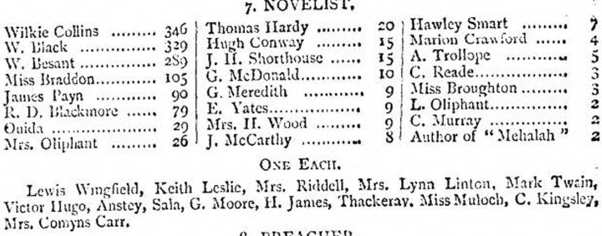
For the other categories, it’s the make up of the challengers and the also rans which is perhaps most revealing. Even accepting that the death of a slew of early and mid-Victorian greats skews the responses here, the list serves as a stark reminder of the contrast between the Victorian canon and the writers the Victorians mostly read. M.E. Braddon, as queen of sensational fiction retains a foot in both camps, as do R.D. Blackmore (famous for Lorna Doone (1869)), and to a lesser extend Margaret Oliphant. But Hardy, even if the bulk of his career lay ahead of him, already had six published novels to his name, and Meredith, whose literary career was drawing to a close in 1885, scarcely feature. Instead Wilkie Collins is pushed hard by Walter Besant, leading light in the formation of the Society of Authors and certainly a significant late Victorian figure, but also by William Black and further back James Payn, two novelists without any pretensions to literary distinction. The prominence of Collins, Braddon, Payn, and Ouida speaks of the enduring appeal of the sort of intricate, plot-driven melodramas which had become a feature of popular writing in the 1860s.
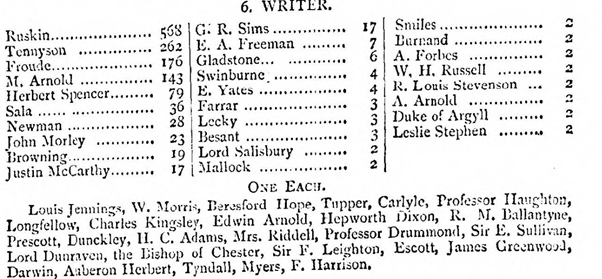
Perhaps most revealing of all is perhaps the ‘Writers’ category. One of the several striking aspects is the relative unimportance of the critics who often loom large in treatments of Victorian culture, Ruskin apart. Yes, Matthew Arnold and Herbert Spencer, from opposite ends of the critical spectrum make respectable showings; and here again periodisation might help to explain the single vote for William Morris and the absence of Oscar Wilde (who did pop with a solitary vote in the ‘actor’ category). But only two votes for Leslie Stephen, or W.H. Mallock, only one for Frederic Harrison, none for Walter Pater, less in the aggregate than the 17 votes for the journalistic commentary of Justin McCarthy, suggests an unexpected lack of influence. Another is the surprising marginality of the poets (compounding the perhaps unexpected omission of a separate category for them), and the historians. Apart from Tennyson, poetry attracts little attention. Apart from Froude, history-writing is largely invisible. The overall impression is of a literary culture rather different to the high-minded intellectualism so often assumed of the Victorians.
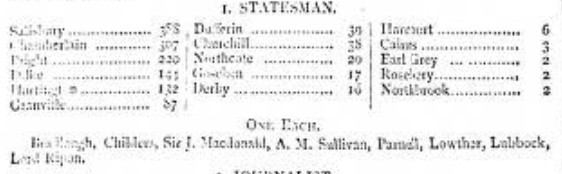
Are there other implications? One might be a reminder of the consequences of the churn of ageing and death on the contours of the cultural configuration as experienced in the moment. 1885 falls interestingly at one of the conventional transition points of the Victorian period, on the cusp of the late-Victorian period proper; and the selections here do reflect this sense of ‘betweenness’. The diffuseness of the statesman votes (even allowing for the artificial exclusion of Gladstone) reflects this, with men who would come to dominate politics, including Chamberlain, Lord Randolph Churchill, and Sir Stafford Northcote, still jostling with politicians of an earlier age, including John Bright and Lord Derby. Parnell, who only a handful of years later would be prominent in similar votes, gets only a single vote. The absence of writers such as R.L. Stevenson, Rider Haggard, Conan Doyle, and Rudyard Kipling reinforces the extent to which the transition to a distinctively imperialist or perhaps fin de siécle sensibility can be dated to precisely the point at which this poll was taken.
And what about the tenth category – ‘humbug’? Here the fact that 46 different options were suggested by at least two voters suggests particularly rich pickings. There was a clear winner and several other popular choices. I wonder if you can work out who they were. (For the results, see my follow up blog, here.)
Martin Hewitt
 Martin Hewitt