(This blog is a continuation of my previous post on the Pall Mall Gazette’s Christmas 1884 competition, in which the editor W.T. Stead asked his readers to nominate the Greatest Living Englishman [sic] in ten categories.)
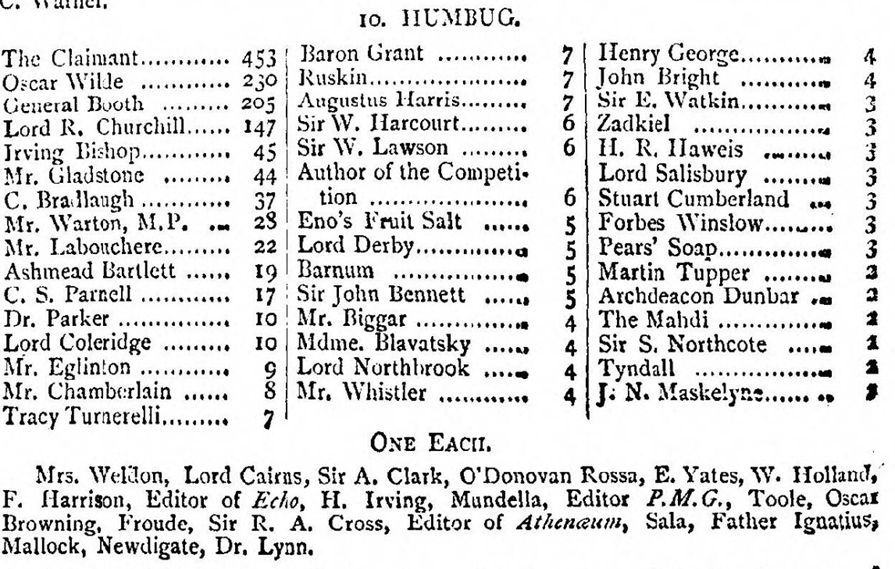
If Stead had hoped to create a particularly comment-worthy set of responses by including the greatest living ‘humbug’ as the tenth and final of his categories he was not disappointed. To identify someone as a humbug was to suggest their virtues were a sham, a mere parade of pretence. In a culture wedded to respectability and committed to earnestness and honesty, nothing so sharply challenged a public figure’s character. Here was a chance not merely to pass wry comment, but to affirm a set of personal and cultural values. The result was by the far the most widely dispersed set of responses to any of the categories. 46 different nominees received 2 or more votes, and there were another 22 single votes. The extent of the spread, as well as the identity of some of the choices, reinforces the sense from the previous sets that not everyone who had entered the competition had done so with the intent of trying to win.
Perhaps the only really unsurprising feature of the resulting list was that the clear winner was Arthur Orton, whose claim to be the long-lost heir of the Tichborne baronetcy had prompted a long-running campaign in the 1870s, drawing heavily on popular anti-aristocratic feeling, but eventually ending with Orton being convicted of perjury and sentenced to 14 years imprisonment. For those not committed to the cause, he was certainly the most notorious imposter of the second half of the Victorian period. And yet, the fact that even so he garnered only 450 votes suggests that the PMG’s readers were looking for something more fundamentally hypocritical.
In second place Oscar Wilde reinforces the importance of this remit. Remember 1885 was before most of Wilde’s more enduring writing appeared, and well before he became publicly embroiled in scandals over his sexuality. He had only graduated from Oxford in 1878, but his aptitude for self-promotion and not least his lecturing in the early 1880s, including a year-long tour in America, had clearly made him synonymous with aestheticism in the public mind, and so with the ridicule typified by Gilbert and Sullivan’s Patience (1881) and Punch’s ‘Maudle’ and ‘Postlethwaite’, the sense that it was a purely performative affectation. (The presence of Sir John Bennett, a London watchmaker, well-known for his flamboyance, and for electoral sharp practices in relation to elections to the City of London Corporation, underlines this).
General Booth, founder and leader of the Salvation Army was a more obvious choice, given the Army’s aggressive disregard for Victorian conventionalities. Otherwise, the relative absence of religious figures – the theosophist Madame Blatavsky and Archdeacon Dunbar (presumably included as a reference to his dabbling in spiritualism) apart – reinforces the foundational religiosity of Victorian culture. The presence of Joseph Parker, leading Nonconformist, is perhaps a reflection of his militant support for disestablishment, coupled with his insistence on religious teaching in Board schools. Otherwise, a preacher like Charles Spurgeon might be vulgar, but he was at least genuine. Instead, the humbugs were Irving Bishop, the American stage thought-reader, who had been based in England in the early 1880s, and whose claims to supernatural powers had been increasingly in the spotlight in 1884, or William Englinton, another fraudulent ‘medium’, or Zadkiel, the personality of a well-known astrology almanack (and perhaps to Richard James Morrison, whose pseudonym it had been up to his death in 1874). Even a largely respectable medic such as Forbes Winslow, the psychiatrist who pioneered the use of hypnotism, is drawn into this suspicion.
Of course, some PMG readers took advantage of the poll to score political points. Dislike of Irish nationalism reflected in the votes for Charles Stuart Parnell and Joseph Biggar, and it was inevitable that Gladstone, whose policies were increasingly divisive, would appear. That these were all also-rans in comparison with Lord Randolph Churchill, the last of the only four figures to garner more than 50 votes, reinforces the suspicion that dislike of flamboyance and narcissism drove the voting. Churchill, leader of the ‘Fourth Party’ in the 1880-85 Parliament, and outspoke critic of the Conservative old guard, was no fringe heckler – he was a leading figure in the Conservative party. But he was young, radical, unwilling to be constrained by convention, challenging established political orthodoxies and visibly ambitious. It seems to have been a combination that touched a collective nerve. (And when the Fireside Companion conducted a similar poll in November 1885, Churchill topped the poll for ‘humbug’.)
Down in the body of the list, many of the nominees are unfamiliar, figures of merely passing notoriety. Charles Warton was infamous for blocking otherwise unopposed parliamentary bills on procedural grounds. Ashmead Bartlett is most likely William Lehman Ashmead-Bartlett, secretary to the wealthy philanthropist Baroness Burdett-Coutts, who though 37 years her junior, had married her in 1881. Artist Edward Tracy Turnerelli is present presumably in reference to the 24 carat gold ‘people’s tribute’ wreath he attempted to present to Disraeli after the 1878 Berlin Congress (which Disraeli refused). Baron Grant was Albert Grant, notorious stock pumper and company fraudster. Some are more of a puzzle. Augustus Harris, the theatre impresario, was included perhaps because of his championing of German theatre and opera in the early 1880s. I’m grateful for the Tom Hughes’s explanation of the presence of the Lord Chief Justice John Coleridge, arising out of an embarrassing 1884 libel case concerning his adult daughter, living unmarried with her partner, while he sat on the bench as the embodiment of legal rectitude.
Above all, what is striking here is the overwhelming force of orthodoxy. There were fewer flippant responses for this category than for any of the others (even if Stead gets a nomination here as well). And this conventionalism is very much of a traditional ‘Victorian’ stamp. There is almost no sign of any sort of fin de siècle anti-Victorianism. Martin Tupper, the exponent par excellence of doggerel Victorianism gets a meagre two votes; Sir Wilfrid Lawson, leader of the campaign for local prohibition gets 6; but there are no votes for Samuel Smiles, despite the relatively recent appearance of Thrift (1875) and Duty (1880). There are no facetious votes for ‘Mrs Grundy’; or for Queen Victoria. Eno’s Fruit Salts gets five votes, but there are none for the Charity Organisation Society or the Lord’s Day Observance Society. The ‘naughty nineties’ may be only five years away, but convention stands forth here as if still set in concrete.
Martin Hewitt
 Martin Hewitt