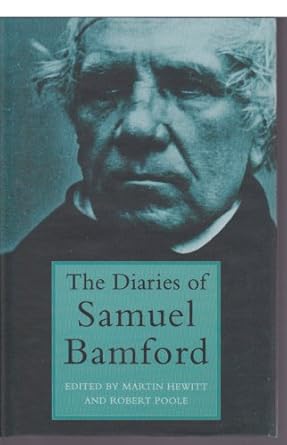
Edited with Robert Poole, The Diaries of Samuel Bamford publishes almost in their entirety, and with full scholarly apparatus, the diaries of this early nineteenth century radical and autobiographer, written towards the end of his life in a period of physical decline and social and political frustrations. It offers one of the fullest and most intimate portraits extant of the private life of a poor working man in mid-Victorian England.
Reviewers’ Comments
Hewitt and Poole’s expertly edited The Diaries of Samuel Bamford attempts a more innovative editorial format than that pursued in the other two volumes under review. They note how, as Bamford’s diary progressed, it evolved into a multi-faceted text: a collage of personal testimony, newspaper cuttings, letters, and memoranda. This working bricolage provides a many-layered testament to the complexities of plebeian masculinities and the social and ideological dynamics of both progressive politics and literary sub-cultures. … Certainly, the diary functions as a site of multiple meanings, providing absorbing insights into the self-construction of this extraordinary Victorian figure, whilst Bamford’s own temperament – prickly, sensitive, forthright, and impassioned – crackles through the pages. … Perhaps most striking, however, is the emotional poignancy of Bamford’s prose. His sombre record of a visit to the Manchester Workhouse in the winter of 1860 where his mother, brother, sister, and uncle had all perished during his incarceration there as a young boy is memorable’. Kathryn Gleadle, ‘Reforming Discourses and Political Practie in Britain, 1760-1872’, The Historical Journal, 47.2 (2004), 491–499.
‘These [admirably edited and annotated] diaries (which also include newspaper articles and a substantial collection of letters) not only provide fascinating details of [Bamford’s] radical activities from 1858 through 1861, but also poignantly reveal the economic hardship of his declining years’. T.L. Crosby, Choice, Jan 2001, 38.5.
 Martin Hewitt